The Ring

A few months ago, we started watching Peter Jackson’s Lord of the Rings movies with Neige and The Prophet.  The director’s cut is on Netflix, which means that once you start watching, the series lasts forEVER.  That last movie is a never-ending battle. But the visuals and emotions and story hold up very well, and you have not seen an Ork until you’ve seen a Peter Jackson Ork. And let’s not even get started on the Elves, except to say that we all want to marry Legolas and Arwen now.

The movies are about so many things, and one thing they are about is how much we love home. In a funny way, London, Ontario, has come to remind me of The Shire. It’s a sweet, safe community full of little houses and little gardens. Everywhere you go you tend to run into someone you know. And when you leave, you know you are in a different – and perhaps more exciting and special – place. Like Paris or Toronto or Bethesda, Maryland.

We weren’t watching LOTR in preparation for anything, mind you. We were just looking for something to watch, especially as the kids had recently been introduced to Dungeons and Dragons, and the LOTR world seemed right for them. In the movies, a comforting and peaceable world is ripped apart by senseless violence, and humble Frodo somehow becomes the one chosen to bear the burden of The Ring so that it can be destroyed and order restored to the world.

Then in October, I learned quite suddenly that I was going to need surgery because my cancer had progressed unchecked, so I dove in and had the surgery, well-supported by a cast of wonderful family and friends. And I came out of the surgery in good shape. But I realized: Shit, I still have The Ring.

I sat through those movies on the couch. I’m not going to lie, I slept through plenty of scenes. But scene after scene, poor Frodo carried that stupid ring. It got heavier and heavier for him, and his friends propped him up and helped him put one foot in front of the other. He learned to trust the equally abject Gollum so that he could continue on the journey, and he never rejected the stupid mission of carrying that ring to Mt. Doom to destroy it. In the end, he succeeded in destroying the ring, a monumental task that made the happy and wished-for ending seem like a dream or a pretend afterlife.

Sometimes it helps to have a metaphor to communicate what you are experiecing, it can fill out the details when you don’t want to. So one morning I mentioned the ring to The Prophet, and he got really excited. “Yes!” he said, “The Ring! Because you agree to carry the Ring, but you don’t know about all the other stuff that’s going to come with it. You don’t know that there will be monsters and a giant spider.”  The giant spider that menaces you in the semi-darkess is the reality.

This week the giant spider is that we found out yesterday that I am to have my ovaries out on Monday. We’re hoping it will be laparoscopic, that the recovery will be easy, that our holidays will still be enjoyable. It’s the reasonable thing to do – what do you need ovaries for when you have two awesome kids? – and the gynecological surgeon is excellent, so I’m in good hands, once again.  It’s just the giant spider behind the Ring.


Boston, you’re my home

We had a lovely week in Boston. We did, as intended, go to the Universal Centre of Knowledge (aka The Dana-Farber Cancer Center), but I will write about that another time – it was fine.  After the long drive to Boston and a few vehicular encounters with Boston drivers, we decided to walk to the hospital, The picture above is the sight that greeted us as we crossed the BU Bridge. Land of my birth! Chilly temple to the wonder of knowledge and frozen nature!

DSC_0013

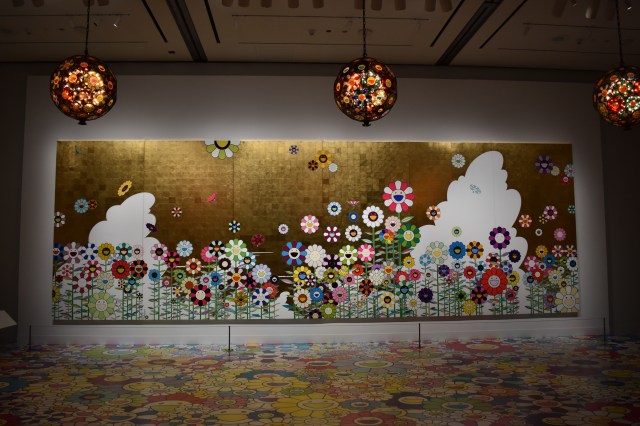
Afterwards, we had to process having jumped through yet another hoop in the steeplechase of life with cancer.  It was a beautiful fall day, so we walked to the Museum of Fine Arts, where our friend Ned was kind enough to lend us his membership card, and the museum was kind enough to have an exhibit comparing Japan’s leading contemporary artist with its grand legacy of artistic genius as represented in the MFA’s collection. Basically, this was my exhibit. An exploration of the Japanese love of expressiveness, playfulness, and nature.

DSC_0022

DSC_0023

DSC_0031

We got to catch up a little with a select grouping of wonderful old friends. Lately I’ve come to the realization that friends make us who we are. Sometimes this includes friends that we haven’t even spoken to in over a decade. Still, we spent important times with them, they said things to us that registered, and now they are part of who we are, even if we have not managed to keep them in our lives in the same way.  We got to reconnect with our friends Kathryn and Ned, who hosted us, and to see how their children have miraculously become teenagers, even if they will always be adorable children in our heads.

After breakfast at Flour and a walk around Harvard Square, we headed west toward home. We revisited the steps of the Unitarian Church, where we met up for our first fateful date.


Then we drove towards home, stopping for lunch at my spiritual home: Books You Don’t Need in a Place You Can’t Find. I never leave without buying a book. Unlike my husband the amazing reader, I do not always read the book that I buy. I think there are still novels languishing on a shelf from my last trip. But the fiction room is not to be resisted. It is a holy place. I still remember the unexpected partial solar eclipse that I witnessed there with Abbie in May 1994.

DSC_0058


After lunch we continued on Route 2 to our stopping place, Porches Inn in North Adams, across the street from Mass MOCA, which recently has expanded to become one of the world’s largest contemporary art museums. We arrived in time for a very short tour of the museum. I wish I could tell you that it was as enchanting as the exhibit on eugenics that The Historian and I saw on our first visit to Mass MOCA in  that we saw when we first went to Mass MOCA decades ago, or that I have a glimmer of a clue as to what contemporary art is, but I do love the large spaces and the possibilities for displaying art.

DSC_0074

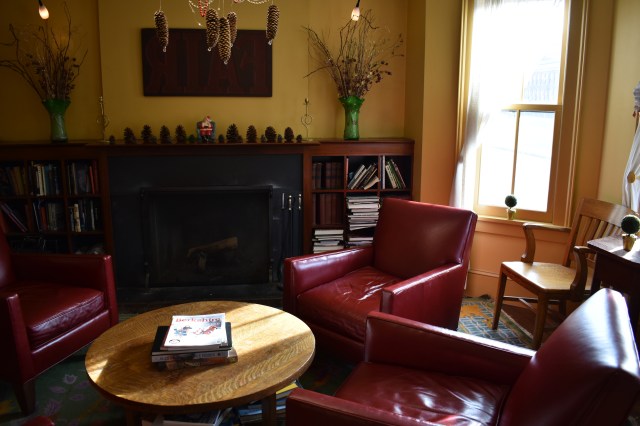
And if you are on steroids and can’t sleep at 5 am at Porches you can go over to the lobby and read in a red leather chair next to a fireplace until your husband wakes up to enjoy a lovely breakfast with you. The room decor may be a little spare, but the buildings are forged from old row houses that used to be occupied by mill workers, making it possibly the most preciously and unabashedly me place that exists in the world. Must come back and bring the children.

If you happen to need a cup of coffee in North Adams, go to Brew Haha and enjoy the signs at the register advertising “Pretty Good Brownies” and, “Please be advised that our house salad is our most popular dish, and ‘Dressing on the side’ is NOT an option because it totally misrepresents our salad.'” I’m too old to fight it. Oh, New England, be not a stranger to me.

How odd to think that we are now old enough to step back into our grown-up past. We reminisced about when we lived in Boston, in our 20s and early 30s, we were learning to be adults/professionals/married people. We had real challenges, and we got through them by becoming ourselves and leaning on all of the great people and things that supported us. Now we’re in the wilderness of the beginning of Middle Age.

It’s harder than you think to talk to your husband

Even though you spend your whole life talking, it is usually about the plan for the day and who is eating what and what laundry needs to be done, that doesn’t mean that you can talk about the Things that Matter with The Person who Matters Most. Even if you have spent a lifetime sharing your plans and dreams and hopes and aspirations, you may not be able to pivot to talking about life and death and the future that you never imagined would be yours.

This is not your therapist or your best friend. This is the person who knows that you got up in the middle of the night and never came back to bed because you were hurting or anxious or overmedicated or whatever.

This is the same person who knows that you have to get dressed in the morning and confront the body that isn’t the body that you thought you would have in your mid-forties, despite eating and living “better”  and exercising more than anyone else you know.

So we go on a trip. And it takes time. And it’s a blessing to have someone that you can talk to. But even so, it takes time. And even when you live side-by-side and experience all the same things, it still takes time to find the words to share the experiences that you are sharing.

This is the person you thought you would grow old with who thought he would grow old with you.

This is the person who comes home to you at the end of the day when you have been reading blog posts by women who died from the same diagnosis that you have right now and who have shared and articulated your worries before you even knew that they were yours. The words of these women may haunt you, and you may have to hide their effects from your children, but you will not be able to hide them from the person who knows you best and observes you most closely.

You did not get married for the “in sickness and in health” clause, but it’s there in the vows anyway.

You can’t just open a conversation with your life partner about disease, illness, life, and death. It’s a slow process of coming together and unpeeling the layers of the onion that allows you to have the actual, true, deep conversation that you need to have.

This realization is the beginning of a tradition of making the time and space to be together, and living within the same truth as your partner.

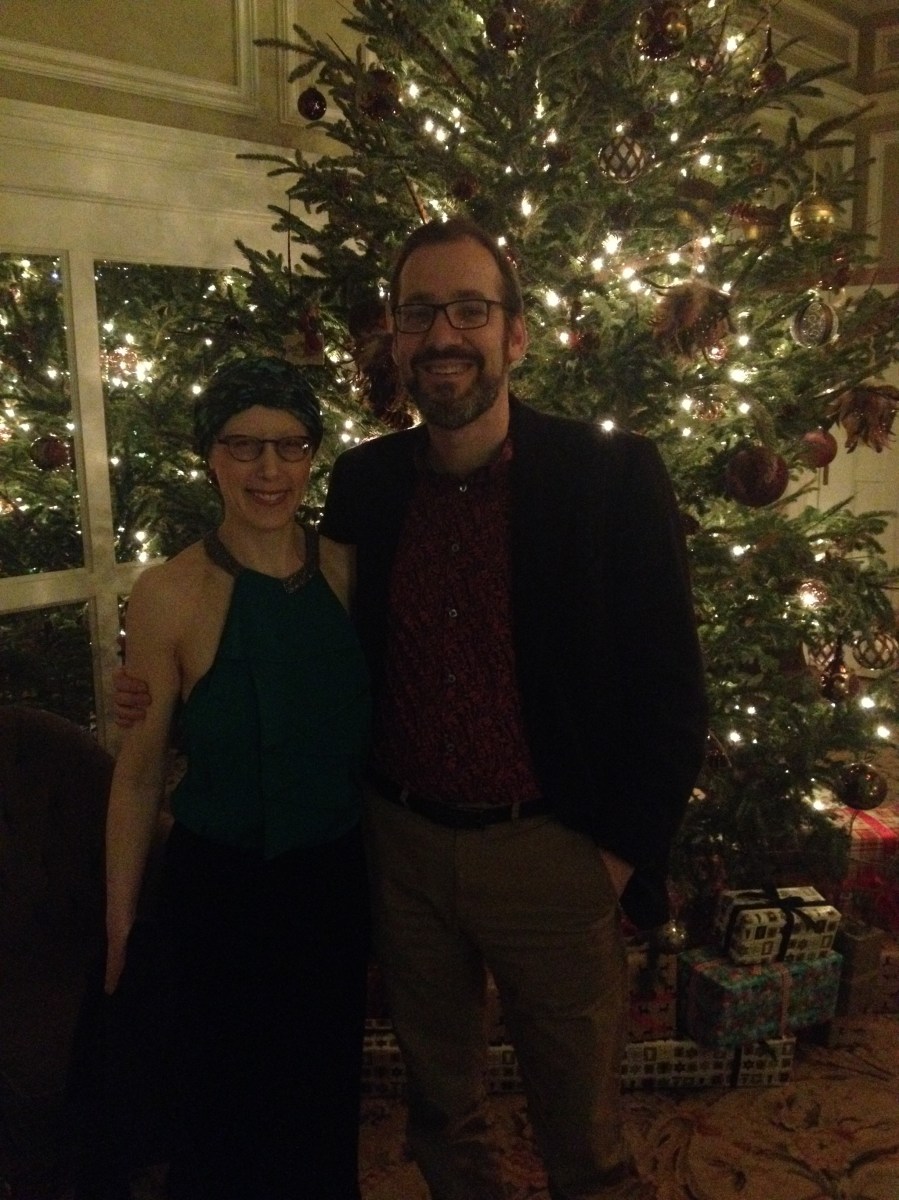
For us, it began last year when my colleagues were kind enough to give us a weekend away together at a fancy inn (shout out to Langdon Hall, omg, also the source of picture above), and my mom was kind enough to come stay with our two children for the weekend. I made the reservation without feeling the need, or even the ability, to be in the same place as my husband for the weekend. We packed ourselves into a car with a little luggage, and my chemo-ravaged body was barely aware enough to make commit to the 90-minute drive. But once we got there, the inn was decorated in its Christmas finery and there was a fresh blanket of December snow on the ground, which we walked through on a beautiful Saturday morning. We had the most amazing meals, which we neither needed nor asked for, but enjoyed nonetheless.  Our room had a fireplace. There was silence for reading, thinking, and talking.

And slowly we are able to talk to each other. Fears are not so difficult to talk about. It’s actually harder to talk about hopes and dreams, the little things that we hope that we can do differently, the changes that we want to improve our lives.

This year we are about to do it again. We are headed to Massachusetts, and we will make a few stops, partly to consult the Medical Experts, and partly to just spend time together. I now know that it is important just to be in the same space, with quiet and no to-do list.  Mostly I think that this is the only way to sync up, to put our spirits in the same place, to simultaneously contemplate the questions: What is this life that we have together?  Is it good?  Is it what we want?

***

When this column came out last winter, it kicked off an informal vigil among many of the women I know to try to follow the author’s illness, It also resonated for me. It’s

Two indisputably great winter recipes

I have made a lot of beef short ribs in my time, and they are a great no-fail winter stew. They are full of fat and connective tissue, and they had a moment 10-15 years ago where they were everywhere because they were so good.

It’s possible that someone would have told you that all the recipes worked, but this recipe, Beef Short Ribs with Carrots and Cumin, is the best. For a while, it was unfindable on the Internets, so I’m not sure what brought it back to Williams-Sonoma’s website, but I have an old print-out of it that I’ve never let go of because it is the only winter beef recipe that you need. There are fancier recipes with wine and other more expensive ingredients, and for some reason they come out not as good. Also, I would like to mention, that beef short ribs are probably the cheapest ethically raised  beef that I can find around here in the dead of winter.  If I’m smart, I’ll remember to put the beef bones in the freezer and use them for bone stock later.  I use Bob’s Red Mill All Purpose Gluten-Free flour so that they are gluten-free, though I’m not sure whether this matters.

Braised Short Ribs with Carrots and Cumin

Ingredients:

  • 6 bone-in beef short ribs, kosher cut, 5 to 5 1/2 lb. total
  • Salt and freshly ground pepper, to taste
  • 1=2 1/2 cups all-purpose flour, as needed
  • 1/4 cup olive oil
  • 6 garlic cloves, chopped
  • 1 Tbs. plus 1 tsp. ground cumin
  • 2 cups beef stock
  • 1 to 2 cups water
  • 1 head garlic, cloves separated, unpeeled
  • 3 large carrots, peeled and cut into large chunks
  • Directions:
  • Preheat an oven to 350°F.Generously season the short ribs with salt and pepper. Spread the flour on a plate. Dredge the ribs in flour, coating all sides. Shake off the excess.In a Dutch oven over medium-high heat, warm the olive oil until nearly smoking. Add half the ribs and brown on all sides, about 10 minutes. Transfer to a plate. Repeat with the remaining ribs.Remove the pot from the heat, pour off the excess oil, and stir in the chopped garlic and cumin. Return the ribs to the pot and set over medium-high heat. Add the stock and enough water to almost cover the ribs and bring to a boil.

    Cover the pot and bake for 30 minutes. Add the whole garlic cloves and carrots and bake until the meat is just tender, about 1 hour more.

    Uncover the pot and bake until the meat and carrots are very tender and the liquid is reduced to a flavorful sauce, about 30 minutes more.

    Spoon off any fat from the sauce. Transfer the ribs, carrots and sauce to individual shallow bowls and serve immediately.

    Adapted from Williams-Sonoma Foods of the World Series, Paris, by Marlena Spieler (Oxmoor House, 2004).


Also, I keep making Lauren’s Spice Cookies from Epicurious. I do mess with the spices because 2 tablespoons of cloves is just too much for anyone these days. Perhaps this recipe is from a different era.  Also, who keeps mace on hand? We use allspice instead. I love this recipe because, like the one above, it’s dead easy. It pleases me, my family, and usually our friends, so I’m making sure to get it down here for anyone who wants it.

Spice Cookies

INGREDIENTS

  • 3/4 cup vegetable oil
  • 1/4 cup dark molasses
  • 1 1/4 cups sugar
  • 2 large eggs
  • 2 3/4 cups all-purpose flour or gf flour
  • 1 1/2 teaspoons baking soda
  • 1 1/2 teaspoons cinnamon
  • 1 1/2 teaspoons ground ginger
  • 2 teaspoons ground cloves (optional)
  • 1 teaspoon ground allspice (optional)

PREPARATION

In a large bowl with an electric mixer beat together the oil, the molasses, 1 cup of the sugar, and the eggs until the mixture is smooth.

In a bowl stir together the flour, the baking soda, the cinnamon, the ginger, the cloves, and the mace and add the mixture to the molasses mixture.

Beat the dry mixture into the wet mixture until it is combined well and chill the dough, covered, overnight.

Form the dough into 1 1/2-inch balls and roll the balls in the remaining 1/4 cup sugar to coat them well.

Bake the balls 3 inches apart on buttered baking sheets in the middle of a preheated 350°F. oven for 10 to 12 minutes, or until the tops crack.

Transfer the cookies to racks and let them cool.


Visting physiotherapist, social worker, and nurse

What is your mandate?

They arrive with a stack of papers, and they have a job to do. I should be smart enough to ask what that job is, but instead, I just sit on the couch or at the dining room table and try to get through the visit. My province has seen fit to fund this phalanx of home care workers, who claim that they have to the power to speed my recovery, help me navigate the system, and possibly keep me out of the Emergency Department, and so they arrive as soon as I am home from the hospital. They supposedly offer services, but at this point it’s not clear that I need them. Also not clear how much they know about my case, since they arrive with a mandate, a stack of papers, and some reason for coming here; but they often end up asking the same questions all over again.

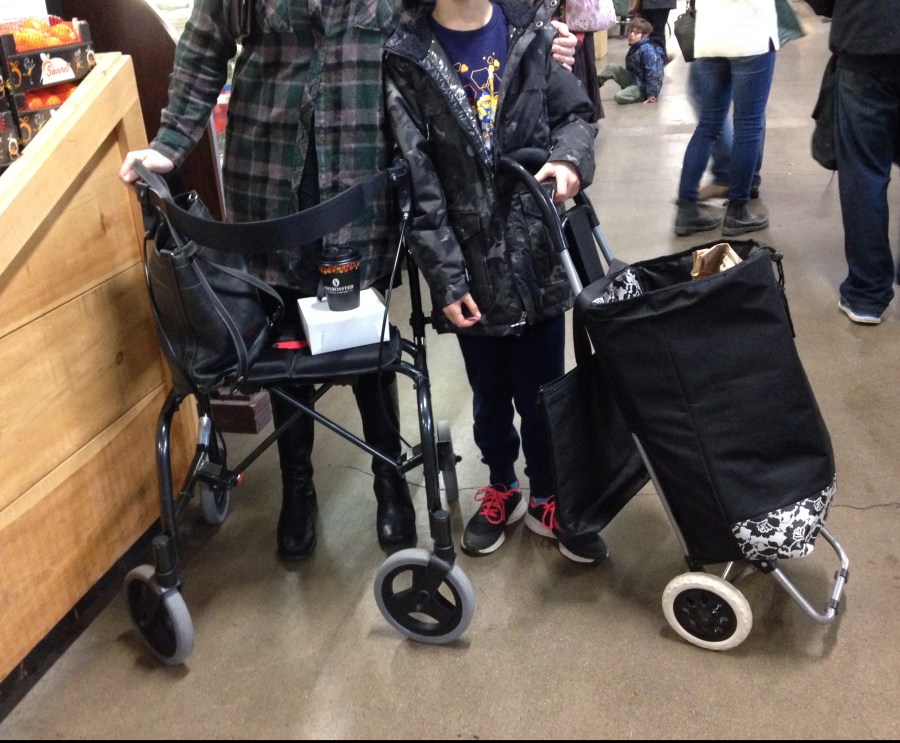
Sometimes they are quite useful, like the physiotherapist who gave me exercises to do, and now I don’t have to go to an office to get exercises to do.  Or the local service that came and left me a walker for use on longer walks.  Now I have a borrowed walker, and it sometimes buys me a little extra deference in the shops or room on the bus (picture above, at the local farmer’s market on Saturday, with The Prophet).

My favorite is the visiting nurse, who is a South Asian woman who appears to be in her late-twenties. She is generally approving of my overall demeanor and education level, noting that I already meditate and drink tea in place of coffee.  She is required to ask if I have any wounds or incisions to tend, whether I require the visit of an Occupational Therapist or the acquisition of assistive devices.  I insist that I do not want a grab bar in the bathroom, I already know how many steps away it is from my bed and how to get myself to the toilet without falling.  In fact, with all of the appointments, it might be better to have fewer visitors, so I discharged the social worker.

The visiting nurse wants to know what number I would use to rate my pain and dizziness. She does not like hearing that I am dizzy, but how else am I supposed to feel just a few weeks after brain surgery?  Sometimes I think I’m normal, then I stand up and find that my head is floating in space somewhere over my body. The sensation is not unlike being pleasantly buzzed, except that it is most of the time. Bending over to pick something up off the the floor is slightly perilous.  I can do most normal things in the kitchen, but I do tend to spill more spices and other things than I used to.

My favorite question is in response to the question of whether I’m getting much sleep, which I am not.  “IS THAT WHY YOUR EYES LOOK LIKE THAT?” she asks. No, I think my eyes look like they normally do. But apparantly, my eyes do not look right. I try to explain that I am half-Japanese, that I have inherited a mixed bag of traits, including light hair and puffy eyes. It’s starting to remind me of the midwestern doctor who told my mother that she must be hepatic because he had never seen an Asian person’s skin before.  When the visiting nurse came back 6 days later she said that my eyes looked much better, so things must be going in the right direction.

Reasons why people have the wrong clothes

As part of my dive into the literature of clothes, I made a list of reasons why experts say that people buy and keep clothing that makes them unhappy. This is a good reminder of when to pass, even if it feels like you should not pass, on things.

  • When your lifestyle has changed but you don’t want to admit it
  • Because it makes you feel bad about yourself for some reason (uncomfortable shoes, a stiff blazer…)
  • Because you think it’s supposed to fit or look differently on you than it actually does (see above)
  • Because you think you’re “supposed to” look good in it
  • Because you need it to be successful
  • Because you don’t want to admit that it is no longer in style or that more time has passed than you are willing to admit since acquiring it.
  • Because you’re afraid of not having anything at all to wear
  • Because you’re afraid you won’t find something better
  • Because you’re afraid of making a fashion mistake or of wearing things that are not age-appropriate through your own choices
  • Because you’re afraid you don’t deserve better
  • Because you think that you’re supposed to have a certain look to match your perceived status

Here is a nice overview of things to do instead of shopping, and here is “the closet confidence challenge.”


I did not make this up: We believed her

I remember watching Anita Hill 25 years ago, and at the time I naively thought that no one would have to go through that again. We gathered around televisions at Amherst College, women and men together, and we all knew that she spoke for all of us.

Then I got to meet Anita Hill after she visited Western to promote a book about Home (Thank you, Monda Halpern.) and she was lovely but did not want to talk about testifying before Congress. Who could blame her? She has accomplished so much, and it was 20 years later. Having dinner with her was a very special treat, as she was a passionate intellectual who believed she was making a difference by bringing her values to the world. I may have thanked her for being brave and telling her story and making a difference, but I only remember how great it was to be in her presence.

Now we see a raft of new allegations of women saying how their own sexual harrassment tampered or squashed their ambitions, even though they were supposed to conquer the world. But after watching Anita Hill testify, I never thought that the world would be the same. Maybe other people went back to Business As Usual, but I was in university, at a watershed moment, and that experience never left me.

The Male Gaze is not something that is owned by males, even if some of them feel like they own it. It is a property of The Patriarchy, and women collude with it as much as men do.

What a woman puts on her body is political, and so is the way that she is treated as a result.

If a woman chooses to be uncomfortable in exchange for looking “professional” that is a political choice. I learned all of these things as a young woman, but they are still serving me today.

The Bright Hour by Nina Riggs

On Mortality

If you only read one book about living with cancer, this is the one to read. I ordered it as soon as my sister alerted me to its publication last June, and then it arrived, and my mom read it all in one sitting before bringing it to me to read. It’s written so beautifully, and contains so much insight. Among my favorite parts:

I am reminded of an image that one of cousins — a woman who lost her husband to a swift and brutal cancer last year — suggested to me recently over email: that living with a terminal disease is like walking on a tightrope over an insanely scary abyss. But that living without disease is also like walking on a tightrope over an insanely scary abyss, only with some fog or cloud cover obscuring the depths a bit more — sometimes the wind blowing it off a little, sometimes a nice dense cover. (p 243)

Serious lounging gift guide

Let’s pretend, for a moment, that this is type of blog that tells you what to buy. Because Black Friday is coming, and I have that side of me, the dyed-in-the-wool Jewish-American consumer side of me. And the holidays are coming. And it’s silly to pretend that presents don’t matter when clearly they do. My husband’s family has a lovely tradition of receiving new pajamas on Christmas Eve, so clearly it’s time to embrace the pajama present concept, even if it happens on Hanukkah and even if I’m late to the pajama party. Last Hanukkah we gave the kids tickets to see Hamilton in Chicago on the first night. They danced for joy, and that cannot be beat. Anyway, for the shoppers …

Have you discovered Thirdlove Bras yet? In a recent post I complained about bras, but I’ve also been on the lifelong hunt for the comfortable bra in all its permutations. This one is supposed to be somethng that you wear around the house, but I’m here to tell you that you can wear this to the grocery store or even to work if you are busy fighting the patriarchy, like all the awesome women I know. I have this one in a size Medium and it seems to be working when I bother to wear it.

When lounging around the house, which is where I’m supposed to be these days, I have to champion a Canadian brand. I have two Aritzia Veronika dresses. They are long plaid flannel shirts. And leggings from a local boutique that are made mostly of bamboo. The boutique is run by an Eastern European engineer who could not work as an engineer in Canada, and it is called Bela Booteek.  And if you remember the 90s, like I do, you might wear a silk slip dress underneath. Just saying.

Can we talk about being a capitalist consumer? I want brick and mortar retailers to be there. Sure, you can order whatever you want online, but can you look at and feel the merchandise? Can you make small talk with the person who picked out the merchandise and lives in the same region as you and who watched the same sunrise? Do you have any idea of what you are getting? Can you lose yourself in a shop with its colors and textures for a few minutes or an hour? Can you come out with a pair of navy and gold botanical print flats that will make nice strangers ask you where you got them when you are at an academic conference? No, no, no. Amazon, I love you sometimes, but I need to keep supporting my local retailers, who for better or worse still provide some of the most vital public space available in the little city where I live.

Also, for lounging around the house: I give you the Jockey 100% cotton pajama pant, a feature that is shockingly hard to find. In the summer, they absorb sweat. In the winter, they are cool and comfortable. If you have ridiculously sensitive skin, then you know that the difference between 100% cotton and 95% cotton is like night and day. So for continuing to manufacture 100% cotton, Yay, Jockey.  However, when the kids come home from school, I have discovered, it is best to be wearing something that passes for street clothes so that your children can count you among the living and not some twilit zombie breed, though you may be so.

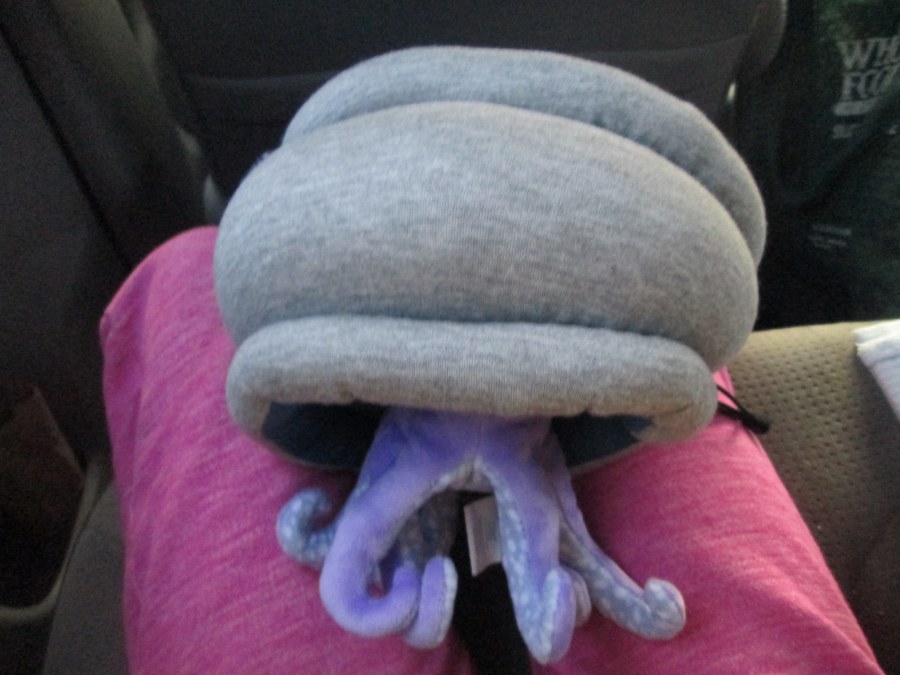
Oh, and a visiting nurse told me that I need to up my napping game. Before all of this insanity hit, I thought that I had a good-enough sleep mask.  Turns out that this is the best sleep mask, a gift from a friend who does nursing shift work. According to The Historian, it kind of makes me look like a bug from outer space. Also, the podcast Sleep with Me is HILARIOUSLY soporific. And the visiting nurse also approves of my meditation practice – I recommend the Calm App as $60/year well-spent.  And if you are really a serious napper, you might consider the Ostrich Pillow. We took the mini version with us on a transAtlantic flight to Paris (see image above, courtesy of Neige), and it worked out quite nicely. What is sleep supposed to look like, anyway? It seems that I’m up for a couple of hours every night, and I’ve come to love the quiet of the house, where I can prowl around and listen to everyone else snore and peek in on my children sleeping and catch up on reading or netflixing or blogging or what have you.

I just got a dress made from this company. It’s an attempt to fulfill a lifelong dream of putting on the same dress for any occasion and feeling comfortable and confident. Is it going to work? You’re going to have to check back with me at the end of the winter on that one. A while back I read this book Women in Clothes, and it had a story about a woman who fell in love with a dress and so she had it made up in different colors and fabrics, and every day she would put on the same dress in whatever fabric/color struck her fancy and dress it up with whatever accessories lit her fire that day. And I thought, wouldn’t that just be amazing, to have one dress that is all that you want to wear every day? One dress that never itched or rode up when you sat down or made you feel overdressed or underdressed? Could one dress do all that? So I took the proceeds from my shoe sales and invested in this dress, but in black:

I’ve finally come to the realization that loose fitting dresses are 100% my jam. I don’t care if they don’t hug all the right places or instantly take 10 lbs off. How about zero hugging and room for food babies? Awesome, thanks!

It was kind of like The Uniform Project, in which a little magic pixie fashion student wore the same dress for a year to protest fashion waste and also to raise money for a girls school in South Asia somewhere. Okay, I can’t fully explain it, but trust me it made sense in 2008. And here is the magic of the “conscious dressing” movement, which seems to be designed to make life easier for the dresser. You can be like Steve Jobs or Barak Obama, and just wear the same thing every day (neutral hoodie or blue/grey suit)! Reduce decision fatigue! Focus on your life and not what you wear! Oh, this message is so seductive.

Stuff Part 2: The clothes

I’ve already written about the Worst Day of My Life, which was the day when I found out I needed brain surgery. That was the day when I went from “living with cancer” to “living with cancer,” if you know what I mean. It was the day when I started out thinking of myself as someone who was handling life’s challenges and living with cancer largely under control. But as the day progressed I realized that I was back at square one, knowing that the cancer was really in the driver’s seat and was likely to pop up at any part of my body and wave its restrictions into my life (no driving, immediate admission to hospital, prep for surgery ….) This is enough to turn your world upside down.

There were more issues than I knew how to deal with, and a raft of new questions appeared. If I could not call the shots in my life anymore, who was I? And what about my family, who surely had not signed up for this insanity? Honestly, for them especially I just wanted a ‘normal’ life. But no, now they eagerly offered me food and rides and company and moral support… it’s enough to make a girl teary, all the time.

Given that there were more concerns than I could possibly hold in my head at once, my first concern was, of course, did I have what I needed to wear for this new life of mine?  In fact, this was a small subset of the question, What is my life, now that cancer appears to have taken over the driver’s seat?  And just like that, rather than ruminate on the new state of my life, I dove into the literature of closet organization.

I peeked down the rabbit hole of minimalism, and it isn’t pretty. I’ve heard this is a common thing for people who are experiencing a health crisis, in which they get overwhelmed by the “stuff” that increasingly fills our lives. I came home from the hospital hopped up on steroids, mind warped by opioids, and could only think about how I needed to SIMPLIFY my life.

The promise is eternal – control your physical existence and you can control your life. The idea first took hold when I was introduced to Marie Kondo’s Life-Changing Magic of Tidying Up. You can reject things! it promised. You can say no the obligations that come with owning and caring for the material. Beyond the organization specialists like Kondo, minimalist blogs offered even a little more, as they held out the promise that you could create a sense of personal attainment through the critical editing of your very existence. Minimalism offers a route to reject consumerism, excess, capitalism, identities

I’ve long known and believed that clothing is important.  As one CBC host recently remarked, “Clothes are a passport to belonging.” Wearing appropriate clothing is how we present ourselves to the world. It’s how we express our desire to belong or to blend in or to stand out. Clothing is what we wrap our bodies in for our own protection and care. I need to wear clothes to signal that I love and care for my body, even when it’s in a state of weakness and need. I need to wear shoes that keep me feeling secure while relearning how to walk. I need clothes to signal that I am still a committed member of society, that I want to be approached, to engage, to connect.

[An aside: I’m not sure that I nailed that last one when I traipsed around University Hospital in a bloodied hospital gown, especially not after I made it all the way past the cafeteria, down to the first floor, and out the front door for a breath of fresh air, swaddled in two hospital gowns and a drooping pair of hospital pants.]

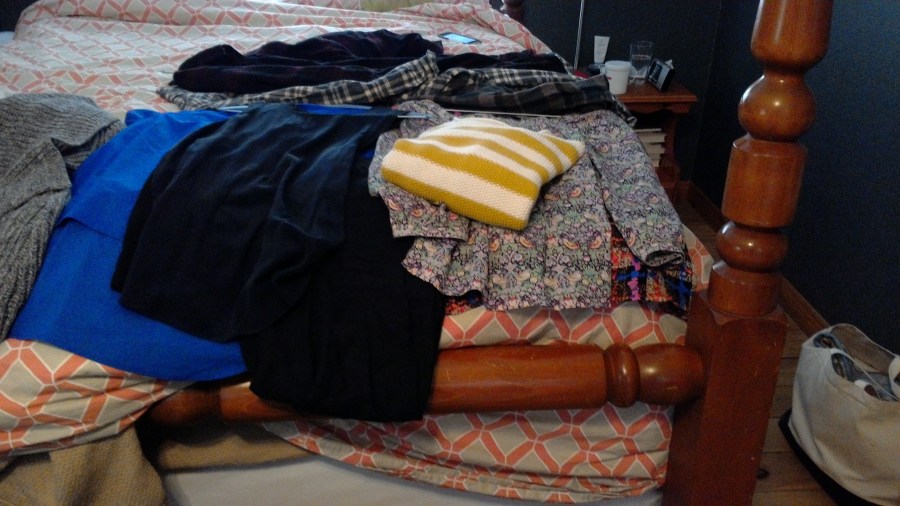
Obviously, this needed to start with my shoe collection. I came home and successfully sold 2 almost-new pairs of boots. I found minimalist blogs like Style Bee and Un-Fancy, both of which offered a way to a soothing palette of colorless clothes that promised to uncomplicate my life so that I could focus on What Really Matters. I took all my clothes out of my closet, piled them on my bed, and created a wardrobe capsule. Keeping busy took my mind off the pain and at least half-convinced myself that I was working towards becoming the self that I needed to be for the coming winter of my … what, exactly? Discontent? Infirmity? Convalescence? Healing? After a few weeks my friends Elaine and Hilary arrived and talked me out of the 2/3 of my wardrobe that no longer fit my daily activities. Some items went out for consignment, some to Goodwill, and some are languishing in storage until the appropriate season for sorting arrives. Hilary now sends me regular photos of herself wearing some of my cast-offs as part of her successful work-from-home lifestyle.

I’ve long sensed a shift coming in how I present myself to the world. When you go from being a young, fertile woman to being a middle-aged caretaker of oneself and others, something shifts. You are no longer in the world to add beauty and desirability, to be admired or pursued. (This was always a rough go for me, anyway.) In such circumstances, a woman may suddenly come to understand her role as one of action and subjective experience, rather than passivity.  This transition has the potential to be liberating and invigorating, or it could be disappointing and erasing, depending on how you happen to experience it.  Style icons can easily shift from Audrey Hepburn, to Iris Apfel and various of my dearest friends.

I guess that now it is time to make a shift, from presenting myself to the world as feminine, attractive, and pliant, to presenting myself as a being in need of self-care and ready for action. When I start asking, “How shall I present myself to the world?” what am I really asking is, “How do I feel about my body, and how do I want others to feel?” I’ve spent a lot of time lately sitting in hospital beds and doctor’s offices reading magazines, flipping through images of women and men dressed to present themselves in various states of action and desirability to the viewer.  #MeToo

  • How do you feel about your body?
  • How do you feel about your identity?
  • How do you feel about your status?
  • When you feel fabric coddling or constraining your stomach, breasts, hips, feet, butt, etc., do you feel comfortable/acceptable/in control/appropriate/participatory?

There is something about the act of choosing and putting on clothes that makes me wonder about how I desire to be seen. The clothing itself is a mediator between my body and the world. It shows me, for example, that time has passed, even if I’m not aware that it has. My brilliant husband observed, “This is you, dealing with your life, in your most you way.”