The Bright Hour by Nina Riggs

On Mortality

If you only read one book about living with cancer, this is the one to read. I ordered it as soon as my sister alerted me to its publication last June, and then it arrived, and my mom read it all in one sitting before bringing it to me to read. It’s written so beautifully, and contains so much insight. Among my favorite parts:

I am reminded of an image that one of cousins — a woman who lost her husband to a swift and brutal cancer last year — suggested to me recently over email: that living with a terminal disease is like walking on a tightrope over an insanely scary abyss. But that living without disease is also like walking on a tightrope over an insanely scary abyss, only with some fog or cloud cover obscuring the depths a bit more — sometimes the wind blowing it off a little, sometimes a nice dense cover. (p 243)

Serious lounging gift guide

Let’s pretend, for a moment, that this is type of blog that tells you what to buy. Because Black Friday is coming, and I have that side of me, the dyed-in-the-wool Jewish-American consumer side of me. And the holidays are coming. And it’s silly to pretend that presents don’t matter when clearly they do. My husband’s family has a lovely tradition of receiving new pajamas on Christmas Eve, so clearly it’s time to embrace the pajama present concept, even if it happens on Hanukkah and even if I’m late to the pajama party. Last Hanukkah we gave the kids tickets to see Hamilton in Chicago on the first night. They danced for joy, and that cannot be beat. Anyway, for the shoppers …

Have you discovered Thirdlove Bras yet? In a recent post I complained about bras, but I’ve also been on the lifelong hunt for the comfortable bra in all its permutations. This one is supposed to be somethng that you wear around the house, but I’m here to tell you that you can wear this to the grocery store or even to work if you are busy fighting the patriarchy, like all the awesome women I know. I have this one in a size Medium and it seems to be working when I bother to wear it.

When lounging around the house, which is where I’m supposed to be these days, I have to champion a Canadian brand. I have two Aritzia Veronika dresses. They are long plaid flannel shirts. And leggings from a local boutique that are made mostly of bamboo. The boutique is run by an Eastern European engineer who could not work as an engineer in Canada, and it is called Bela Booteek.  And if you remember the 90s, like I do, you might wear a silk slip dress underneath. Just saying.

Can we talk about being a capitalist consumer? I want brick and mortar retailers to be there. Sure, you can order whatever you want online, but can you look at and feel the merchandise? Can you make small talk with the person who picked out the merchandise and lives in the same region as you and who watched the same sunrise? Do you have any idea of what you are getting? Can you lose yourself in a shop with its colors and textures for a few minutes or an hour? Can you come out with a pair of navy and gold botanical print flats that will make nice strangers ask you where you got them when you are at an academic conference? No, no, no. Amazon, I love you sometimes, but I need to keep supporting my local retailers, who for better or worse still provide some of the most vital public space available in the little city where I live.

Also, for lounging around the house: I give you the Jockey 100% cotton pajama pant, a feature that is shockingly hard to find. In the summer, they absorb sweat. In the winter, they are cool and comfortable. If you have ridiculously sensitive skin, then you know that the difference between 100% cotton and 95% cotton is like night and day. So for continuing to manufacture 100% cotton, Yay, Jockey.  However, when the kids come home from school, I have discovered, it is best to be wearing something that passes for street clothes so that your children can count you among the living and not some twilit zombie breed, though you may be so.

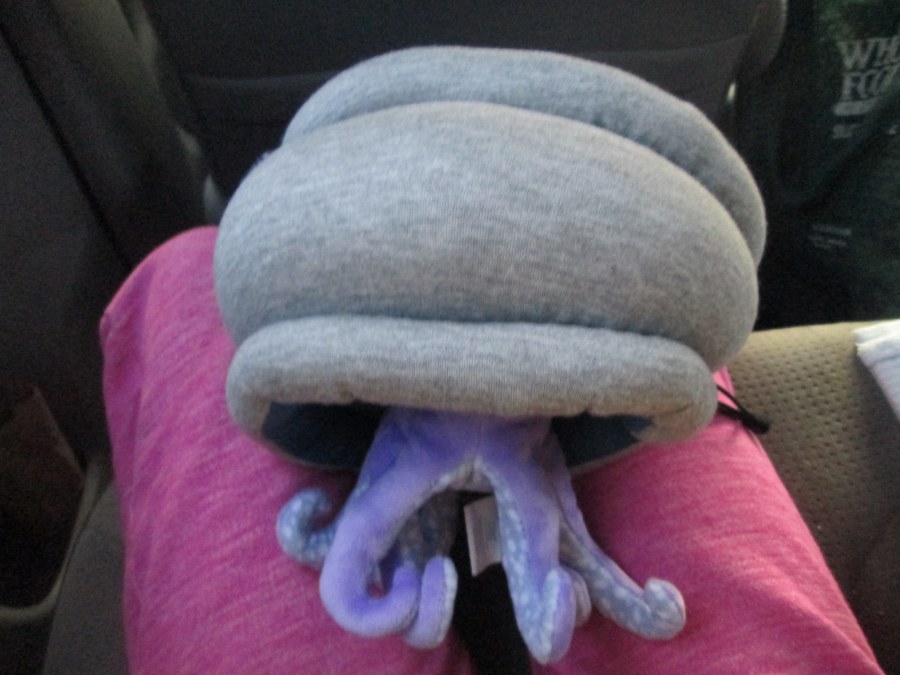
Oh, and a visiting nurse told me that I need to up my napping game. Before all of this insanity hit, I thought that I had a good-enough sleep mask.  Turns out that this is the best sleep mask, a gift from a friend who does nursing shift work. According to The Historian, it kind of makes me look like a bug from outer space. Also, the podcast Sleep with Me is HILARIOUSLY soporific. And the visiting nurse also approves of my meditation practice – I recommend the Calm App as $60/year well-spent.  And if you are really a serious napper, you might consider the Ostrich Pillow. We took the mini version with us on a transAtlantic flight to Paris (see image above, courtesy of Neige), and it worked out quite nicely. What is sleep supposed to look like, anyway? It seems that I’m up for a couple of hours every night, and I’ve come to love the quiet of the house, where I can prowl around and listen to everyone else snore and peek in on my children sleeping and catch up on reading or netflixing or blogging or what have you.

I just got a dress made from this company. It’s an attempt to fulfill a lifelong dream of putting on the same dress for any occasion and feeling comfortable and confident. Is it going to work? You’re going to have to check back with me at the end of the winter on that one. A while back I read this book Women in Clothes, and it had a story about a woman who fell in love with a dress and so she had it made up in different colors and fabrics, and every day she would put on the same dress in whatever fabric/color struck her fancy and dress it up with whatever accessories lit her fire that day. And I thought, wouldn’t that just be amazing, to have one dress that is all that you want to wear every day? One dress that never itched or rode up when you sat down or made you feel overdressed or underdressed? Could one dress do all that? So I took the proceeds from my shoe sales and invested in this dress, but in black:

I’ve finally come to the realization that loose fitting dresses are 100% my jam. I don’t care if they don’t hug all the right places or instantly take 10 lbs off. How about zero hugging and room for food babies? Awesome, thanks!

It was kind of like The Uniform Project, in which a little magic pixie fashion student wore the same dress for a year to protest fashion waste and also to raise money for a girls school in South Asia somewhere. Okay, I can’t fully explain it, but trust me it made sense in 2008. And here is the magic of the “conscious dressing” movement, which seems to be designed to make life easier for the dresser. You can be like Steve Jobs or Barak Obama, and just wear the same thing every day (neutral hoodie or blue/grey suit)! Reduce decision fatigue! Focus on your life and not what you wear! Oh, this message is so seductive.

Stuff Part 2: The clothes

I’ve already written about the Worst Day of My Life, which was the day when I found out I needed brain surgery. That was the day when I went from “living with cancer” to “living with cancer,” if you know what I mean. It was the day when I started out thinking of myself as someone who was handling life’s challenges and living with cancer largely under control. But as the day progressed I realized that I was back at square one, knowing that the cancer was really in the driver’s seat and was likely to pop up at any part of my body and wave its restrictions into my life (no driving, immediate admission to hospital, prep for surgery ….) This is enough to turn your world upside down.

There were more issues than I knew how to deal with, and a raft of new questions appeared. If I could not call the shots in my life anymore, who was I? And what about my family, who surely had not signed up for this insanity? Honestly, for them especially I just wanted a ‘normal’ life. But no, now they eagerly offered me food and rides and company and moral support… it’s enough to make a girl teary, all the time.

Given that there were more concerns than I could possibly hold in my head at once, my first concern was, of course, did I have what I needed to wear for this new life of mine?  In fact, this was a small subset of the question, What is my life, now that cancer appears to have taken over the driver’s seat?  And just like that, rather than ruminate on the new state of my life, I dove into the literature of closet organization.

I peeked down the rabbit hole of minimalism, and it isn’t pretty. I’ve heard this is a common thing for people who are experiencing a health crisis, in which they get overwhelmed by the “stuff” that increasingly fills our lives. I came home from the hospital hopped up on steroids, mind warped by opioids, and could only think about how I needed to SIMPLIFY my life.

The promise is eternal – control your physical existence and you can control your life. The idea first took hold when I was introduced to Marie Kondo’s Life-Changing Magic of Tidying Up. You can reject things! it promised. You can say no the obligations that come with owning and caring for the material. Beyond the organization specialists like Kondo, minimalist blogs offered even a little more, as they held out the promise that you could create a sense of personal attainment through the critical editing of your very existence. Minimalism offers a route to reject consumerism, excess, capitalism, identities

I’ve long known and believed that clothing is important.  As one CBC host recently remarked, “Clothes are a passport to belonging.” Wearing appropriate clothing is how we present ourselves to the world. It’s how we express our desire to belong or to blend in or to stand out. Clothing is what we wrap our bodies in for our own protection and care. I need to wear clothes to signal that I love and care for my body, even when it’s in a state of weakness and need. I need to wear shoes that keep me feeling secure while relearning how to walk. I need clothes to signal that I am still a committed member of society, that I want to be approached, to engage, to connect.

[An aside: I’m not sure that I nailed that last one when I traipsed around University Hospital in a bloodied hospital gown, especially not after I made it all the way past the cafeteria, down to the first floor, and out the front door for a breath of fresh air, swaddled in two hospital gowns and a drooping pair of hospital pants.]

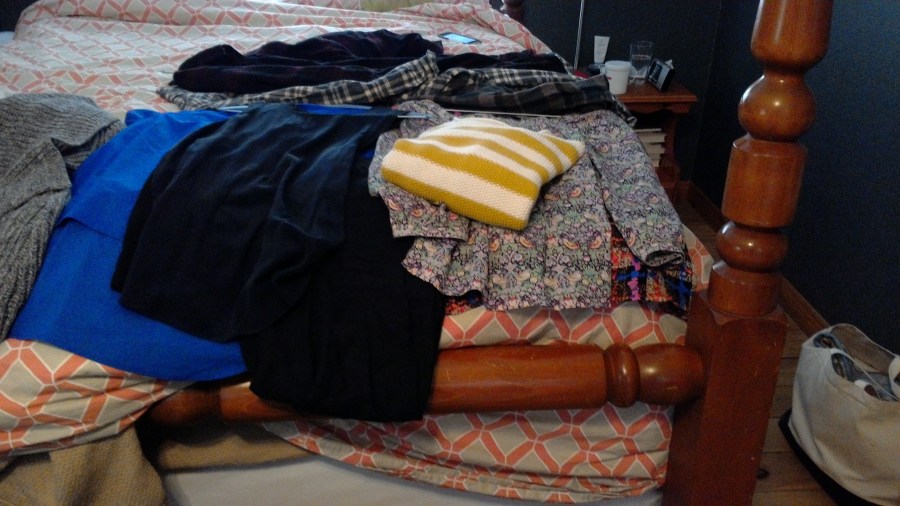
Obviously, this needed to start with my shoe collection. I came home and successfully sold 2 almost-new pairs of boots. I found minimalist blogs like Style Bee and Un-Fancy, both of which offered a way to a soothing palette of colorless clothes that promised to uncomplicate my life so that I could focus on What Really Matters. I took all my clothes out of my closet, piled them on my bed, and created a wardrobe capsule. Keeping busy took my mind off the pain and at least half-convinced myself that I was working towards becoming the self that I needed to be for the coming winter of my … what, exactly? Discontent? Infirmity? Convalescence? Healing? After a few weeks my friends Elaine and Hilary arrived and talked me out of the 2/3 of my wardrobe that no longer fit my daily activities. Some items went out for consignment, some to Goodwill, and some are languishing in storage until the appropriate season for sorting arrives. Hilary now sends me regular photos of herself wearing some of my cast-offs as part of her successful work-from-home lifestyle.

I’ve long sensed a shift coming in how I present myself to the world. When you go from being a young, fertile woman to being a middle-aged caretaker of oneself and others, something shifts. You are no longer in the world to add beauty and desirability, to be admired or pursued. (This was always a rough go for me, anyway.) In such circumstances, a woman may suddenly come to understand her role as one of action and subjective experience, rather than passivity.  This transition has the potential to be liberating and invigorating, or it could be disappointing and erasing, depending on how you happen to experience it.  Style icons can easily shift from Audrey Hepburn, to Iris Apfel and various of my dearest friends.

I guess that now it is time to make a shift, from presenting myself to the world as feminine, attractive, and pliant, to presenting myself as a being in need of self-care and ready for action. When I start asking, “How shall I present myself to the world?” what am I really asking is, “How do I feel about my body, and how do I want others to feel?” I’ve spent a lot of time lately sitting in hospital beds and doctor’s offices reading magazines, flipping through images of women and men dressed to present themselves in various states of action and desirability to the viewer.  #MeToo

  • How do you feel about your body?
  • How do you feel about your identity?
  • How do you feel about your status?
  • When you feel fabric coddling or constraining your stomach, breasts, hips, feet, butt, etc., do you feel comfortable/acceptable/in control/appropriate/participatory?

There is something about the act of choosing and putting on clothes that makes me wonder about how I desire to be seen. The clothing itself is a mediator between my body and the world. It shows me, for example, that time has passed, even if I’m not aware that it has. My brilliant husband observed, “This is you, dealing with your life, in your most you way.”


Bras

Today, with great reluctance, I choose to go there, to talk about bras. This is not an easy thing, as the Third Wave feminist who is wary of being identified as a “bra burner” brings up the thing that no one wants to talk about all my life. As a recent piece in The New Yorker explored, we were all just assumed that we would wear bras when we reached a certain age as part of our social contract: You go out in public? You wear a bra! My 11-year-old daughter tells me that she is the only one in her class who does not wear some kind of breast restraint device on a daily basis. If I were not on self-imposed feminist restriction from commenting on her physique, I would tell you that they are all, to my eyes, in the strictly bra-optional phase of development. If that even is a phase.

This is the thing that no one wants to talk about until this year. For some reason, bralessness has become a fashionista trend, with Rihanna, Kendall Jenner, and countless off-duty models and fast fashion houses championing this look (I’m looking at you, The Sartorialist and Everlane).

There is even a small and contested field of science that debates the relative merits of bra vs no-bra. And here is at least one thing worth considering. I remember back in the day when I was breastfeeding and commenting on the unwieldiness of the whole operation, my brother-in-law, the biologist/reproductive endocrinologist, commented that humans are the only mammals who have enlarged breasts even when they are NOT breastfeeding. Why would this be? It must be because the enlarged breast is considered an attaction to the male partner, and so the breasts get larger at puberty and stay that way though all of adulthood, an invitation to cancer. In other words, I came to wonder decades later, Is the male gaze killing me?

My history: to the outward eye, my breasts are fine, maybe ideal. I’ve always worn about a 32D, making my breasts substantial for a smallish-medium frame. But this is actually the Breast Cancer Danger Zone. Breasts like mine contain relatively little fat and are dense with breast tissue, meaning that on a mammogram everything lights up, yielding little useful data for the technologist and radiologist looking for signs of abnormality. On my recent Race for the Cure walk I enjoyed comparing notes with an older, larger woman who bragged that her radiologist just loves her mammograms because the fat deposits help divide everything so neatly. “It may be true, but I wanted to punch him!”

[Edited to add: The New York Times and others might tell you you can lower your cancer risk by reducing alcohol and smoking and increasing exercise, but who is there to tell you that high-density breasts are in themselves a cancer risk? Or that being a woman or man with breast tissue is a cancer risk? You are. Tell your friends.]

All my life I have searched for the bra that allowed me to move about as freely as possible in the world, to do my job and live my life in comfort. I have gone to the stores with the fitters that women whisper about, I have bought the expensive brands, I have been measured and re-measured. In addition to wanting breasts that “behave” by displaying the appropriate shape, size, bounce, placement, malleability, I have the additional challenge of ever-changing eczema and dermatitis that results in rough pink and brown patches on my breasts, under the bra band and under the straps. Some of these red, rough patches were ignored by me and later actually revealed themselves to be evidence of lymphatic breast cancer that looked atypical and were dismissed by even my wonderful breast surgeon. So you see, bras and breasts are not neutral things, they have implications for my health and survival, and possibly for yours and for all our daughters’.

On my most recent visit to the surgeon, she took a good hard look at all of the patchy, irritated skin on and around my breasts and she could not figure out what to biopsy. It all looked potentially normal and potentially cancerous at the same time. This is what even the best bra will do to you. I went over all the skin with her and tried to pick out some suspicious spots to biopsy. [spoiler: all came back as ‘normal’ eczema] I’ve read the articles, I’ve done the fittings, I’ve spent the ungodly amounts of money on getting the right bras from the right purveyors. It is time to ask the question, who are we moulding our bodies to please? And at what cost?


Some strategies for getting labelled “Impulsive” by Clinical Neuroscience Inpatient Nurses

  • Meekly submit to wearing yellow bracelet that says, “Call Don’t Fall” and agree to ask for assistance to mobilize out of bed and go to the toilet. Then, on the 3 occasions in the night when no one responds to multiple calls for help, shuffle to toilet alone, dragging drain poll along.
  • Get scolded for landing improperly on drain lines when returning to bed from toilet. Incidentally, the lines are not secured in the way that the neurosurgeon has requested.
  • Refuse to wear hospital gown or other coverings in overheated “semi-private” room
  • Refuse to wear disposable briefs that exacerbate dermatitis/eczema, thus requiring nursing staff to see your rashy bum when checking the soundness of lumbar drains
  • Repeatedly request cold packs to be placed between rashy sweaty body and hot plastic mattress
  • Ask nurse on last night, “When am I due for pain medications?” You want to believe the nurse, who replies with the guileless smile of Sutton Foster, “Honey, if you only rate your pain at a ‘2,’ I’m just going to give you Tylenol.”/Me: “I just want to make sure that we don’t fall behind in pain meds.” A much more dour Sutton Foster shows up an hour later with a syringe full of subcutaneous Dilautid and unceremoniously empties it into my bicep. Aaaaah.

Know that whatever you do, your polite Canadian husband will have to answer for your behaviour when he arrives in the morning. “What’s that, my wife’s refusing to wear clothes? Well, I’m not sure that qualifies as cognitive decline…”

You Should Be So Lucky

If it needs saying ever, it is worth saying now: I am lucky to be sick in Canada, and specifically in Ontario. An activist friend (hat tip, Renee Lansley) posted this article, describing two sisters’ experiences of breast cancer in Toronto and California.  Rob tells me that there is also this video from the same case. It describes better than I could the positive side of illness in Ontario, where serious universal medicine is the responsibility of the collective.  While much has been written comparing the different systems, this article is particularly relevant for breast cancer patients.

Even before I was deemed “sick,” I was grateful to know that everyone, from my neighbours to the people who pour my coffee, has access to the same system of healthcare that I do. When illness strikes, my husband (always by my side) and I calmly get into our car and drive a few minutes to our excellent, local teaching hospital, where we can be assured of getting the standard of care for every problem identified.  We pay for parking and that’s about it, and by now we’ve learned where to get the best deals on parking.

The article mentioned above draws attention to the thick stack of bills that the U.S.-based sister confronts as she navigates her cancer, a stack that I don’t have to worry about. The author estimates that the same treatment for the same disease costs Ontario about 10% of the cost of California- based sister, likely because of the efficiencies built into our single-payer system with one point of cost-negotiation and nearly zero private administrative costs. But the most important thing, to the author and to me, is that it allows the sick person to just be sick and not to simultaneously sink days into the process of paying bills and making phone calls.

Of course, it would be naive to suggest that our system is perfect. Having spent enough time with physicians and health care professionals to know how dedicated they are, I do my best to act as the “good patient.” I put my education, social capital, and research skills to use asking the “right questions” and doing my research, even when the questions are annoying and repetitive.  Sometimes they come in handy later.  I carefully track which medications I take when, and I report back to the right doctor at the right time on side effects. Doctors look at me and think, “She’s a good patient, this operation/procedure won’t be wasted on her.” Perhaps my treatment might not be so good if I weren’t so well-educated and affluent.

I’ve also learned a thing or two so far, and am bound to know more in the future. Being a good patient does not mean minimizing pain. Recently I had the experience of a few procedures in which I was only too happy to let the doctors know just how they made me feel. Ultimately, I think this was a good thing for all of us. So what if I’m being a big baby, it turns out that the more you get stuck, the more it hurts. The stitches that you get in the hours after a lumbar puncture might be truly nauseating, and it’s fair to say so at the time.

Talk about lucky – turns out that I had brain tumours in the right place – the cerebellum, which is where they are operable. Along with so many other things, I did not know that there were “good” places to have brain tumors. Also, I did not know that my little Canadian city has a well-respected and well-established centre for neurosurgery, which also happens to a great place to need to neurosurgery and follow-up care. That’s lucky.

The day after I came out of surgery, I found out that Gordon Downie succumbed to his brain cancer, a case that was closely followed by all the Canadians I know, intensifying the significance of my experience. Rob quietly watched the documentary of his farewell tour in the week following my surgery. In roughly the same time frame, MBC activist Beth Caldwell also succumbed to her cancer, another example of a brave woman showing a way that life can go with this stupid disease.

So the moral of the story is, health care is not to be taken for granted. There is a real benefit that comes from covering everyone, from taking health care out of the hands of the private system and into the realm of the public. To say to every human being, “We will take care of you,  no matter who you are, even if you have a pre-existing condition,” is to say that you value every human being in your community, without any qualification that you or someone else might dream up. And this approach provides good quality, uninterrupted care that may ultimately result in better survival for those with chronic conditions. This is a matter of real political import.  I urge my American friends to put their political weight behind it, and I urge my Canadian friends to stop and think about what this really means to us.

This is not to say, either, that the U.S.-based system has treated me badly. When I was a teacher in Massachusetts, I had access to the best health care anywhere. And now that I’m in the market for a second opinion, I may once again find myself Boston-bound to take advantage of the best and most cutting edge clinical knowledge available. When I do, I will once again find myself between two systems, figuring out how best to be the successful patient in each one.  It is helpful to know what you are dealing with.

Stuff

Few people I know would doubt that we have too much stuff. Over the course of my lifetime, the cost of ordinary goods like food, clothing, and home supplies has decreased, as adjusted for inflation, so that very few necessities are out of reach for the typical family. We end up with so much stuff chaotically crammed into our closets, pantries, desks, kitchen cupboards, etc, that sometimes it’s easier to just buy something new than to try to hunt down the old thing and figure out if it’s appropriate. Added to that, if it’s a piece of children’s clothing that you are looking for, there is a good chance that it will be outgrown before you find it.

I realized the magnitude of this problem over the summer when we had to move out of our kitchen in order to allow a contractor to renovate. Moving food out of the old refrigerator into the new, smaller storage fridge that we had put the basement, how many bottles of mustard and jars of hoisin sauce did we have? How many medium-sized jars got lost, crowded Condiment Purgatory in the back of the fridge? It turned out I had 3 jars of hoisin sauce and 4 of mustard, most likely because there is only one recipe that I like to make with hoisin sauce, so if I decided to make it on a whim, I didn’t remember what ingredients we had at home and found it more expedient to buy hoisin sauce on the spot in the grocery store.  There was a similar process for the many pounds of beans that turned up in the Great Kitchen Pack-Up.

The problem is many times worse at my parents’ house. I seem to remember an occasion when my brother-in-law went searching for mustard in their fridge and found 8 jars, all of which had expired. Some the mustards had expired before my parents even moved into their house, suggesting that they had moved expired mustard from the kitchen of their old home to the new. Hmmm. [If you’re curious, skip to the bottom to see how this turned into a conversation about racial identity.]

As the summer kitchen renovation approached, I decided that this is a real problem worth facing and strategizing around. For one thing, I had 3 pounds of red lentils to eat up, and I don’t even like red lentils. For another, I read that North Americans throw away almost half the food that they buy, and that if you ate all of the food that you bought you could possibly reduce global warming. I thought about my dear and creative friend Kathryn, who took on a New Years’ resolution to see how many dinners she could make in a row without shopping for ingredients. She had to be thoughtful about what she had and sometimes make substitutions, but the answer was that she was able to make many dinners without buying any new ingredients. Her experience, along with my week of eating detested red lentils, led me to wonder where we got our sense of the need to accumulate stuff in our kitchens. Why, for example, will I impulse buy some random item in the farmer’s market, thinking, “Oh, I saw a nice maitake and kabocha curry recipe the other day, maybe I’ll make that…”  Spontaneity can be exciting, or it can lead to an overabundance of Japanese produce in your food storage space. Also, I come from a long line of frugal self-deniers who would prefer to spend less money rather than more. I’m the girl who can keep squeezing toothpaste out of the same spent tube for a week or more after my husband has declared it better to just throw it out and get a new tube.

Moving out of our kitchen I discovered drawers full of partially-used flour, pasta, rice, beans, dried fruit, nuts…all things I love and need but was not using.  Our culture makes it so easy to accumulate and acquire new things and harder to use and enjoy what we have. To use up your beans you need to find the recipe that you like and the time to make them. And our lives are not set up to be generous with time, at least not mine. When I stop and think about it, this accumulation of stuff is a symptom of the striving lifestyle of late capitalism.  We strive to be successful parents, professionals, partners, friends, human beings, etc. So my kids eat homemade meals, The Historian and I read academic journals in our spare time, and I exercise and eat kale every day; but all of that does not make for a fulfilling life. It does not even keep us safe from cancer, does it?

The decision to do a modest renovation of our little galley kitchen was a commitment to having a space where we could enjoy spending time preparing the food that we eat.  After a few months of chaos, we have an awesome kitchen. Having packed everything up, we have attempted to unpack only what we need are are working on culling the rest. I discovered duplicate spices and gave them to people who said they could use them. We donated some usable food to the local Food Bank. We ate stuff up. For the sake of streamlined design, we got a slightly smaller fridge for the new kitchen and now anything that gets used less than once a week is stored in the basement extra fridge. I’m making a big effort to only buy what we need, and so now we can actually see the back of the fridge, cabinets, etc.

win_20171105_10_47_36_pro.jpg

This is not just about our kitchen, and it’s not just about stuff. It’s about the way that we understand what it means to live our values. I’ve had some time to dip my toe into the literature about mindfulness and minimalist lifestyles, starting with this great post.  It turns out that I can’t let The Market decide what is important to me, these  are decisions only I can make.

  • I love to spend time in the kitchen, experiment with recipes, see ingredients transform into something new.  I love to cook for myself and also for family and friends.
  • Nothing beats spending time with the people I love. A relaxed dinner of a bowl of soup and a salad together can be as nice as an elaborate meal that I spend all day on.
  • There is no winning at life if you don’t know what you value.

Okay, off now to tackle that maitake that’s sitting on my new counter.

***

Digression: Because everything is connected, this led to the following discussion around our little nuclear dinner table.

Me: You can put any of these condiments on your sausage and potatoes.

Kids (a.k.a. Neige and The Prophet) lay claim to hot sauce, mustard, relish, or whatever catches their fancy.

Me: You know, when I was growing up, we never put condiments on the table. We had a refrigerator full of mustard that we never used. Is that because it was the ’80s, or because I’m descended from hoarders? Or is it an ethnic thing?

Husband/The Historian: We always had condiments. But that’s because we’re WASPS. British food doesn’t traditionally have any flavor on its own, so we need condiments.

Me: Do you guys know that you’re White, or WASP?

N: I never thought of that before, I know that I’m Jewish, but most people don’t know that I’m 1/4 Japanese and they’re surprised to hear it.

H: Yup, you’re Anglo Saxon and Scottish, too, whether you want to be or not. That’s the thing about privilege. It’s not something you get to have or not. Also, when people assume that you are White, then you get treated as White, whether you want that or not….

It seems that my little Canadian-American-Jewish-Japanese-WASP progeny were blissfully unaware that these are labels that get stuck on them whether they want them or not. It’s not enough to think that you are leading by example, you have to have the actual discussions.
 

Pinktober

When I was newly diagnosed with breast cancer, many people who have been through this wringer said to me, “Welcome to the club that you never wanted to join.” And in doing so, they may as well have said, “We’re here for you; we see you; we understand your pain and fear and anxiety.” But the truth is that there is another club within the breast cancer club that people don’t like to talk about or even acknowledge, and that is the club that I am in, the club for those diagnosed with Metastatic Breast Cancer (MBC), or Stage IV Breast Cancer. MBC refers to breast cancer that has spread beyond the breast and lymph nodes, it is the only form of breast cancer that is life-threatening, and it is incurable. It bears repeating: Metastatic Breast Cancer is the only form of breast cancer that is life-threatening. A docile tumor can stay in the breast for your entire life and not cause you trouble, but the aggressive, cagey tumors that spread to bones, lung, liver, or brain are the ones that kill.

It came out of the blue; I didn’t even know that you could be diagnosed with Stage IV cancer with no prior history of breast cancer.  What’s more, I had no family history with the disease, and generally had no lifestyle or risk factors to mark me as someone who should be on guard against breast cancer. The diagnosis came as a surreal joke, but the truth is that the majority of those diagnosed with breast cancer have no known risk factors. So when the Breast Cancer Awareness Month campaigns rolled around last October, with its ubiquitous advertisements and pink ribbons, I was feeling raw and shell-shocked in the way that you do for the first 1 or 60 months after diagnosis.

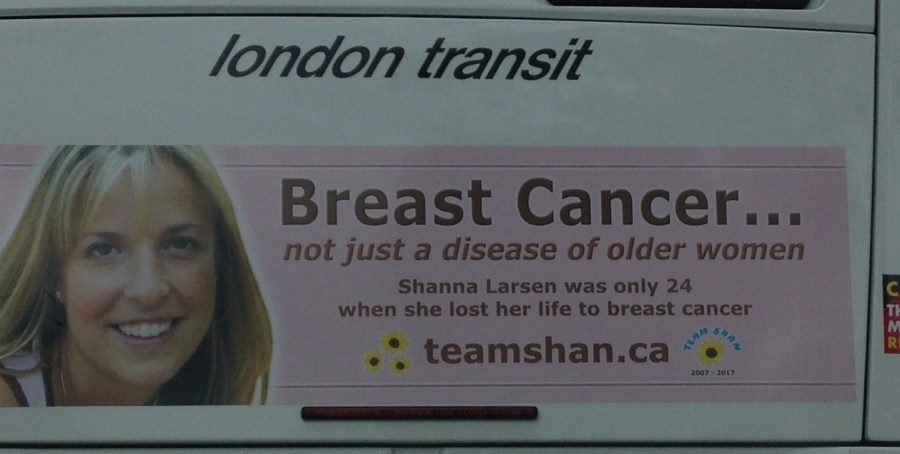
That’s when I encountered the bus. I traveled the same route as the bus when I picked my kids up from school each day. Most days in October I trailed behind the bus staring up at its large, pink advertisement plastered across the back that went something like, “Even young women can get breast cancer. Check your breasts regularly. Early detection = cure.” Screw you, bus.

I had checked my breasts regularly, had even found the lumps that would be diagnosed malignant, and had found them early enough that in an initial consultation, a surgeon told me that my chances of surviving were very good. That was before the CT scan that found suspicious lesions in my liver, lesions that would prove to be malignant, that would signal that my cancer was no longer considered curable. I realized with a sense of shame that I would never be a “survivor” in the sense that I would go through the breast cancer experience and come out on the other side.

For the 6-10% of women whose breast cancer is metastatic at initial diagnosis, there is no hope of getting through the experience, just of persisting within it. It doesn’t matter if you find it “early,” as some breast cancers are so aggressive that they metastasize before they are detectable.  Some would claim that you can be a “survivor” while living with breast cancer, but that seems disingenuous to me, as our doctors tell us that we will never have a life after cancer. Women who have been diagnosed and treated for breast cancer also face a risk of developing MBC. In total, about 30% of breast cancer patients will develop MBC.

Given that MBC is the most dangerous form of breast cancer, you would think that there would be a lot of research on it, wouldn’t you? You would be wrong. According the Metastatic Breast Cancer Network, only 7% of breast cancer funding has gone to studying MBC. The Global Status of Advanced/Metastatic Breast Cancer’s 2016 report found that, similarly, over the past decade only 7% of scientific papers on breast cancer related specifically to MBC.  Furthermore, while survival rates for early stage breast cancer have made some gains in the past decade, survival rates for MBC patients have remained about the same. The upshot is that while breast cancer itself has a fairly high profile–judging by the number of pink ribbons I see, as well as the number of fund-raising emails I get every October—MBC is both under-funded and under-studied.

How has this happened? For years we embraced the idea that increased screening, vigilance, and early treatment of all types of cancers would result in better survival for the population overall. As a result, doctors found and treated more cancers, including cancers that did not need to be treated. More recently, it is becoming apparent that we need to understand why and how cancer metastasizes if we are to develop effective treatments for all patients.

And there’s a darker side to this problem. We need to ask the question, is it possible that early stage breast cancer gets more research funding because it affects a larger population, thus offering a larger market for new drugs? Or is it simply a more effective marketing tool, to tell potential donors that by giving money to efforts to detect and treat breast cancer early, they can save lives? The book Pink Ribbons, Inc. by Samantha King argues that breast cancer fundraising campaigns have been predicated on providing an upbeat message promising survival for those who comply with breast cancer screening. This strategy has instituted a “tyranny of cheerfulness” over breast cancer patients, especially during the annual Pinktober awareness campaigns. There was little room in this narrative to talk about MBC.

The “early detection = cure” message is a cruel joke to members of the MBC community. How many nights did I lie awake wondering, if I had just found the suspicious lumps 3 or 4 months earlier, might I, then, be a “survivor”? That pink bus seemed to be suggesting that if I had just fulfilled my personal responsibilities…. Last October, one blogger, a woman who is at high risk of breast cancer due to carrying the BRCA1 gene, had the audacity to write, “My doctor told me that women who follow the rules don’t die from breast cancer.” Such statements put the blame squarely on patients for the spread of their cancer. To which I say, screw you and the bus that you rode in on.

It’s not fair to blame patients for their illness, especially when what is needed is more research and more focus on MBC. If you are receiving fundraising messages for Breast Cancer Awareness month, please ask yourself the questions: Is this fundraiser going to benefit all breast cancer patients or just those in the early stages of the disease? Is the message focused on early detection and treatment, or is it focused on responding to the needs of all, including the most imperiled? If you would like to donate to support breast cancer research, please consider giving to an organization that recognizes the need for more research and support for MBC patients.

On October 1, I took part in my local Run for the Cure event to mark Breast Cancer Awareness Month. Given my skepticism towards these efforts, I was not sure what to expect. But, as the old feminist adage goes, Sisterhood Is Powerful. Gathering with so many people of all ages marking their personal losses from breast cancer as well as their collective hope for a cure made me feel supported. Indeed, flawed as this movement may be, it has gone a long way towards making breast cancer a popular cause. There was a time when people would not even say the word “cancer,” and now I can be celebrated for living with it. (“You’re amazing!” one young volunteer enthused when I went to pick up my free pink t-shirt.) More importantly, as I walked the course with friends who have been through the breast cancer experience, it opened up a space for us to have conversations that would otherwise feel out of place. We talked about facing fear, the places where we find strength, and dealing with the limits of scientific knowledge.

This year that bus is back with a large pink ad, proclaiming, “Breast Cancer . . . not just a disease of older women,” next to a photograph of a vibrant young women, telling us she “was only 24 when she lost her life to breast cancer.” This acknowledgement that women die from breast cancer suggests that the message is moving in the right direction. Over the past year, I have learned that there is no shame in having MBC, and by telling my story I can change the collective understanding of breast cancer to include those of us living with the disease, not surviving.


What is pain?

I thought that pain was the thing that hurts, but now that I’m here, recovering from brain surgery, I realize that I don’t really know what pain is. When I woke up from my surgery, I just felt swollen and stiff all over and also somewhat numb. I didn’t know what could move and what couldn’t. I was doing so well that I skipped the intensive care recovery room and went straight into neurology observation. (I think, it’s all a bit fuzzy.) In the observation room, there were 6 patients and 3 nurses. The nurses were required to make sure that we were awake every couple of hours, that we knew which end was up (literally) and to ask us to rate our pain on a scale of 0 to 10.

I didn’t know what to say. Was I in pain? My head felt like it might explode. Maybe it was supposed to feel that way after being cut open. It wasn’t pain exactly, more like an extraordinary amount of pressure, like what I felt like when I was in labor with no drugs, but that turned out okay.  There was a woman to my right complaining of pain, saying she had to see the doctor, that her pain was unbearable, and all I could think was, “I can’t go to sleep until this woman’s pain is under control.” But it never was under control that night, not after a visit from the resident on call and administration of additional pain meds. At one point I think she got tired and said, “I’m sorry, I’m just not used to throbbing like this.” I will never know what kind of pain she was in and whether it got better, but it’s not my job to know, either.

As the days wore on, I had to rate my pain less frequently, but the nurses and doctors still asked every time they saw me. And it was clear that the number that I gave them back, meaningless to me, had the power to trigger action. I also learned that pain does not necessarily feel like a hurt. Instead, I was in uncontrolled pain with my normally low blood pressure spiraling upward, my body consumed by mild shakes that I could not control, and swelling in my neck precluding normal swallowing of even small sips of water and medication. Still, on that first day after surgery, one of the nurses had said, “She’s swallowing fine, you can cancel the visit from the Speech Language Pathologist.” Luckily, my friend Sarah, the pediatrician/public-health-officer/epidemiologist/outward-face-of-syphilis, had a talk with my team to let them know that my pain situation was not under control and insisted that it be addressed before bedtime (at least before the resident’s bedtime). Reluctantly, the team switched me back to pain injections instead of the slower acting tablets that they had put me on.

But to go home I had to get off the injections. The nurses strongly encouraged me to try to stretch out the time that I spent between pain meds to wean myself as soon as possible. On day 3 after surgery the nurse told me that she wanted to make sure that my pain was below a 5. As long as I told her it was below 5, she was happy. I’m not sure what she thinks below 5 means, but to me it means that I can swallow, am not shaking, have normal blood pressure, and don’t feel the dread of encroaching stiffness in my neck.

Turns out, pain is different for every person, and some people have dedicated their lives to understanding it from different perspectives, such as those of physicians, nurses, patients, social scientists, etc.  When I was first diagnosed with breast cancer, some people joked, “Welcome to the club that you never wanted to join!” But I consider the club of people who live with chronic disease to be another important one for me, and I am grateful to them for teaching me a bit about what it means to live in a body that is at odds with itself or with society at large. One friend and disabilities activist, Layla, posted on her Facebook feed yesterday that she was required to “provide documentation of pain from a phantom limb” to the Powers That Be. We can agree that is funny, right?

Now it’s a week after surgery and I am running out of pain medication once again. I went to my family doctor today and talked through what I can expect. She is mostly reassuring, but sometimes the conversation verges on the ridiculous:

Them: Do you have a headache, or do you have pain in your head?

Me: Do you mean other than the place where you cut my head open and sewed it back together?

WIN_20171023_11_56_42_Pro

The Worst Day of Your Life

The Worst Day of Your Life might not start out that way. Maybe it is a Thursday, you get up early to get the kids ready for school and make yourself a perfect 3-minute fresh egg from the farm in town. You take the kids to the dentist, where they get the dental seal of approval, and then to school. Then you go to your favorite coffee shop and get a perfect latte. And as you are paying for your latte, your phone rings, and that’s when it takes a turn.

It’s the nurse at your oncologist’s office, they have your results from yesterday’s CT scan and would like to see you that day, as soon as possible. That’s bad news. You call your husband, who is out of town that day, and clear your schedule so that you can go, with your stoic Asian mother, to the oncologist’s office.

The radiation oncologist greets you with a grim face and reddened eyes. She tells you that the CT showed tumors in your brain, as well as swelling, and apparently the swelling is threatening, well, everything. There is a neurosurgeon waiting for you in his office, he has OR time on Monday and thinks he can fit you in. You medical oncologist tells you that he is “shocked and horrified” that the cancer has proven itself to be so devious as to figure out how to take up residence in your brain, protected by the blood-brain barrier from the drugs that seem to have beaten back cancer in the rest of your body.

Leaving your mom at home to wait for the kids to come home from school, your friend Rachel drives you to see the neurosurgeon because you need someone to go with you and also because you are now not allowed to drive. The neurosurgeon is a compassionate, competent, unaccountably humble superhero with magic hands. He patiently shows you your scans, a series of cross sections of your brain, highlighting the blobs of concern. He explains the procedure and you try to follow along, lightly grasping the sequence of cutting, removing, draining as outlined. What you do grasp: you must do something and soon. There is no time for careful consideration or second opinions or phoning a friend. You sign the consent form on the spot.

Then off you go to the MRI, the scan that will reveal in greater detail what is happening in your brain. You lie in a noisy machine knocking and rattling around you, head in a cage with padding to keep everything still for 45 minutes. This is a lot of time to absorb the shock of the past 3 hours, and you wonder whether your crying and shaking will interfere with the scan.

Next back to the neurology floor, where you are admitted to a hospital bed, and you have to send your friend home for your toothbrush because when you woke up this morning you thought the day would end at home in your own bed. And that was the worst day of your life. So far.

But if that was the worst day, then the next day might be a little better. You get a bit of sleep in hospital, you meet with the doctors you need to meet with and encounter no obstacles for surgery. The MRI shows no new bad news, and in your new reality that passes for good news.  Your husband, the light of your life, arrives and holds you close. A few close friends drop by. They cry, you cry, you all laugh. You have an amazing talk with your rabbi, and if you’re one of those skeptics who doesn’t know what the point of organized religion is, THIS IS THE POINT. Friends call from far away offering warmth and wisdom. You feel loved. You feel validated. Your life, ever more fragile, still has meaning.

And at the end of the day, your husband brings your children to visit you. They are quiet and frightened but also relieved to see that you look like yourself, and eager to snuggle up with you on the tiny hospital bed while your husband reads a chapter from Harry Potter and the Half Blood Prince. You know that you have everything that you need.

*****************

So that’s where I am at. Having finished all the pre-operative preparations on Friday, I got to go home for the weekend, and now I’m back in the hospital bed ready for surgery tomorrow. I’m in good hands – literally, this surgeon is fantastic – surrounded by supportive family and friends. This is a very unexpected turn of events, but I am facing it head on. As always, I welcome your prayers and messages of support. I may not be able to answer them, but they do shore up my strength.